.png)
Lake Bohinj: Why Clean Alpine Lakes Decline Quietly


In the previous article on Lake Bohinj, comparisons were made with systems such as Lake Constance and Lake Geneva — lakes that experienced severe eutrophication in the second half of the twentieth century and were later subject to large-scale restoration efforts. These examples remain important. They demonstrate that decisive phosphorus management can reverse ecological decline.
However, they belong to a different phase.
They are lakes that had already crossed a critical threshold.
Lake Bohinj has not.
In this article, we examine a set of comparable Alpine lakes — not as distant case studies, but as functional analogues — and ask what their trajectories, successes, and failures reveal about Lake Bohinj and the practices that sustain or undermine its stability.
Lake Bohinj
Lake Bohinj does not belong to the category of lakes that should be understood through the logic of post-collapse recovery. It belongs to a far more sensitive category: deep, cold, oligotrophic Alpine lakes, where nutrient concentrations are low, the water is clear, and the system appears stable.
According to ARSO, total phosphorus concentrations in Lake Bohinj remain low (around 5 µg/L), meaning the lake is still formally classified as oligotrophic.
Yet its ecological status has already declined from "high" to "good". This distinction is critical.
It means that while the chemical baseline remains within the oligotrophic range, the biological system is already responding.
In conventional interpretation, low nutrient levels are treated as a sign of ecological stability.
In reality, in such systems they signal sensitivity.
Because the lake operates close to its limiting threshold, even small additional inputs of phosphorus — or subtle changes in the catchment — can trigger disproportionately large biological responses.
The system is not stable.
It is finely balanced.
To understand Bohinj, the reference frame must therefore shift.
The relevant comparisons are not lakes that have already collapsed, but those that still appear stable — yet are undergoing change beneath the surface.

The Bohinj Paradox: When Numbers and Symptoms Diverge
Before turning to comparative cases, one structural feature of Lake Bohinj deserves to be named directly. Routine monitoring continues to report low total phosphorus concentrations, while visible biological indicators — periphyton coverage on littoral substrates, episodic algal signals, shifts in transparency — suggest that the system is responding to something that the standard chemical baseline does not register.
This is the Bohinj paradox: a system in which the headline numbers continue to confirm "oligotrophic" status while the lake itself communicates, through its biology, that something has changed.
Three mechanisms can produce this divergence, and all three are likely operating simultaneously.
The first is internal loading. In stratified Alpine lakes, phosphorus stored in deep sediments can be remobilised when thermal stratification weakens or when hypolimnetic oxygen declines. The phosphorus that drives biological response in the productive zone may not arrive from the catchment in the year of measurement. It may arrive from the lake's own memory.
The second is spatial and temporal aliasing. Standard monitoring captures the open water column at fixed intervals. Biological response, however, concentrates in the littoral zone, in narrow seasonal windows, and in episodic events triggered by rainfall or heatwaves. A sampling regime designed to characterise mean conditions will systematically miss the dynamics that actually drive ecological state.
The third is stoichiometric shift. Phosphorus is one variable. The ratio of nitrogen to phosphorus, the availability of silica, and the timing of nutrient pulses determine which organisms respond and how. A lake can show falling phosphorus and rising biological signal at the same time if other elements of the nutrient regime are changing.
Read together, the paradox is not a contradiction. It is a diagnostic. It tells us that the indicators we are using were designed for a different kind of lake — one whose problem was excess, not balance.
Lago di Tovel
One of the clearest comparable cases is Lago di Tovel in northern Italy.
A mountain lake in a protected area, Tovel was historically famous for its regular summer phenomenon of red-coloured water, caused by the dinoflagellate Tovellia sanguinea (formerly classified as Glenodinium sanguineum; Moestrup et al., 2006). In 1964, the phenomenon disappeared abruptly.
Crucially, this was not the result of visible pollution or sudden collapse. It was the outcome of gradual changes in the catchment — particularly in land use and nutrient input. Experimental studies later confirmed that even relatively small changes in phosphorus concentrations can significantly affect the dynamics of these organisms (Flaim et al., 2004; Borghi et al., 2006).
The system did not collapse.
It changed state.
Beyond scientific studies, local historical accounts provide an additional layer of understanding. Descriptions of the "red lake" consistently link the intensity of the phenomenon to seasonal conditions, livestock presence, and nutrient availability. As traditional grazing practices declined and nutrient inputs decreased, the conditions that sustained the bloom disappeared as well (Il Rosso del Lago di Tovel, ilovevaldinon.it).
These accounts are not scientific evidence in themselves, but they align with experimental results and reinforce a key point: the system did not simply lose a phenomenon — it reorganised in response to changing inputs.
The deeper lesson of Tovel is uncomfortable. The change was first registered not by instruments but by the disappearance of a visible signal that the local population had observed for centuries. The institutional system noticed afterwards. The lake spoke before it was measured.

Attersee
A different but equally important perspective comes from Attersee in Austria. One of the cleanest lakes in Europe, Attersee maintains extremely low phosphorus concentrations, often below 0.5 µg/L (Dokulil & Teubner, 2005), and serves as a reference system within the European framework for Alpine lakes.

Yet Attersee also reveals a structural limitation in how ecological quality is interpreted. Chemical purity does not necessarily imply ecological integrity. The shoreline is heavily influenced by infrastructure, transport, and tourism, affecting habitat structure even when water chemistry remains excellent.
A lake can remain chemically "clean" while its ecological structure is gradually altered.
This is precisely the scale at which early change in Bohinj must be read.
Traunsee
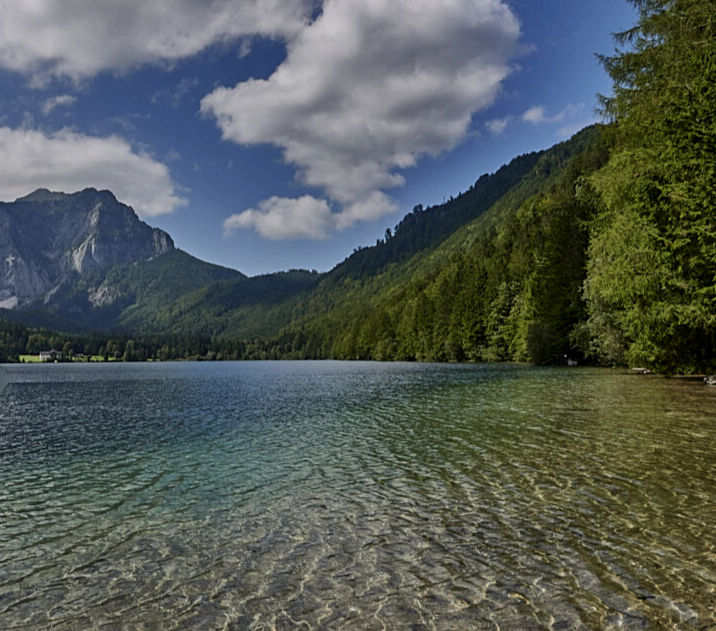
A third dimension is provided by Traunsee, where long-term datasets extending over decades enable the identification of slow-moving trends (Dokulil et al., 2002).
Without such temporal depth, individual measurements become ambiguous. They describe a moment — not a trajectory.
Traunsee demonstrates that oligotrophic status does not imply immunity to pressure. Historical industrial inputs and subsequent management interventions show that even deep Alpine systems require continuous adjustment and cannot be treated as self-stabilising.
Its long-term datasets reveal a further critical point: changes in such lakes are rarely abrupt. They accumulate gradually until a threshold is reached — at which point the system shifts far more rapidly than management can respond.
Lago di Garda
If Tovel illustrates how a sensitive Alpine system can reorganise quietly, Lago di Garda illustrates the opposite scale of the same problem: how a large, deep, pre-Alpine lake can remain ecologically borderline for decades despite continuous, high-resolution monitoring.
Garda is the largest lake in Italy and one of the most intensively studied deep lakes in Europe. The long-term programme led by Nico Salmaso and the Edmund Mach Foundation has produced a multi-decadal record of phytoplankton, nutrient dynamics, and stratification that has no equivalent in the Slovenian system. The relevance for Bohinj is not the size — Garda is incomparably larger — but the epistemic infrastructure: the lake is observed at a frequency, depth resolution, and taxonomic granularity that allow change to be detected before it becomes visible.
Two findings from this work translate directly to Bohinj.

First, Salmaso and colleagues have shown that in deep Alpine and pre-Alpine lakes, complete winter mixing has become irregular under warming. In years with weak mixing, deep phosphorus is not redistributed to the surface; in years with full mixing, the lake receives a sudden nutrient pulse from its own depths. The biological response is therefore not driven by annual catchment inputs alone, but by the frequency of full overturn (Salmaso et al., 2018; 2020). For a stratified lake like Bohinj, this is the central mechanism behind internal loading. It also means that any monitoring regime that does not resolve the winter–spring transition with sufficient frequency will miss the year in which the system actually moves.
Second, Garda has demonstrated that phytoplankton community composition shifts before biomass shifts. The species that dominate a deep Alpine lake under low-phosphorus conditions are not the same species that dominate under intermittent pulses, even when total chlorophyll remains within the same range. By the time biomass-based indicators register a clear change, the community has already reorganised.
The implication for Bohinj is direct. A monitoring system that reports total phosphorus and chlorophyll-a is reporting the slowest-moving variables in the system. The fastest-moving variables — taxonomic composition, littoral periphyton, the timing and depth of the spring bloom — are not part of the standard reporting cycle.
Garda is not a model to imitate. It is a demonstration of what it costs, institutionally and scientifically, to actually see a deep lake change.
Königssee
The closest structural analogue to Bohinj is Königssee in Germany, located within Berchtesgaden National Park.
Both are deep Alpine lakes within protected areas, subject to strong tourism pressures.
The difference is institutional.

Berchtesgaden operates its own research programmes, maintains continuous monitoring, and produces scientific outputs (Siebeck, 1982). Scientific understanding is embedded directly in management.
In Bohinj, this integration is weaker.
Slovenia does have a monitoring system that complies with the Water Framework Directive. However, compliance does not equal adequacy.
The directive defines minimum sampling frequencies that have repeatedly been shown to be insufficient. In practice, this means a small number of samples per year at fixed stations — a regime designed to confirm classification, not to detect change. Studies on Lake Mondsee demonstrate that low-frequency sampling often misses critical signals — including short-term biological responses and extreme events (Tolotti et al., 2017), and may even misrepresent phytoplankton dynamics (Salmaso et al., 2017).
More recent research intensifies this concern. Ho et al. (2019, Nature Communications) showed that Alpine lakes are undergoing rapid changes linked to warming, while Woolway et al. (2020, Nature Geoscience) demonstrated that lakes are warming faster than oceans.
The combination matters. Warming compresses the temporal windows in which biological response occurs and amplifies internal loading by weakening or shifting stratification. This is not an additional pressure layered on top of nutrient dynamics. It is a multiplier of existing sensitivity. A lake with unchanged external phosphorus inputs can show rising biological signal purely through thermal restructuring of the water column.
Change is accelerating.
Detection systems are not.
This leads to the central structural problem.
Monitoring Is Not Protection
A monitoring system produces measurements. A protection system produces decisions. These are not the same thing, and the distinction is the point on which most institutional responses to Alpine lakes silently fail.
A monitoring system answers the question: what is the current state of the lake?
A protection system answers a different question: what change in state requires what action, by whom, within what timeframe?
The first question has a technical answer. The second question has an institutional answer — and it is the institutional answer that is missing.
In a protection system, every monitored variable is connected to a decision threshold. Crossing the threshold automatically triggers a defined response: reassessment of the catchment, restriction of a specific pressure, additional sampling, public communication. The measurement is not the end of the process. It is the input to a decision architecture.
In a monitoring system without this architecture, measurements accumulate. Reports are produced. Classifications are confirmed. The data exist. The decisions do not.
This is the condition that produces what can be called the illusion of control — the institutional confidence that flows from the existence of measurements, regardless of whether those measurements are connected to anything that can act on them. The lake is being watched. Whether anyone is empowered to respond when the watching reveals something is a separate question, and in most Alpine systems it is an unanswered one.
Lake Bohinj currently exists in a narrow zone.
It is still sufficiently preserved to avoid alarm.
Yet sufficiently sensitive for change to begin below the detection threshold of the existing system.
The question is no longer whether the lake is clean.
The question is whether we will recognise change in time.
And whether we will act before the system crosses a threshold that cannot be easily reversed.
Weissensee

A complementary perspective comes from Weissensee in Austria.
Unlike reference systems such as Attersee, Weissensee is not defined by extreme oligotrophy, but by something equally relevant for Bohinj: the active management of tourism pressure within a sensitive Alpine lake system.
The lake operates under a long-term model that combines strict environmental regulation with economic activity. Motorised traffic on the lake is heavily restricted, wastewater infrastructure is carefully controlled, and tourism is structured rather than left to diffuse growth.
The result is not a "pristine" system, but a managed equilibrium.
This distinction is important.
Weissensee does not demonstrate how to preserve a lake without pressure. It demonstrates how to maintain stability under pressure — which is precisely the condition in which Bohinj operates.
What Weissensee additionally shows — and what is rarely discussed in the Slovenian context — is that the management model is grounded in a binding agreement between local actors, not only in regulation imposed from above. The economic operators on the lake have accepted constraints because those constraints are the precondition for the value they extract. Stability is not enforced against the local economy; it is co-produced with it.
This is the structural feature that distinguishes a managed lake from a regulated one.
Five Things to Remember
Bohinj is not a lake for restoration, but for early detection.
Low phosphorus means sensitivity, not safety.
Clean water does not mean an intact ecosystem.
Without long-term, high-frequency, and taxonomically resolved data, there is no real understanding of trajectory.
The core problem is not monitoring. It is the absence of a decision architecture that connects measurement to action.
Selected Sources
Slovenian Environment Agency (ARSO), Environmental Indicators – Phosphorus in Lakes (Ljubljana: ARSO, 2024).
European Parliament and Council, Directive 2000/60/EC establishing a framework for Community action in the field of water policy (Brussels: European Union, 2000).
G. Flaim et al., 'Blooms of the Dinoflagellate Glenodinium sanguineum in Lake Tovel', Phycologia (2004).
Ø. Moestrup et al., 'Tovellia sanguinea sp. nov. (Dinophyceae) — A Dinoflagellate Causing the Reddening of Lake Tovel', European Journal of Phycology (2006).
F. Borghi et al., 'Changes in the Trophic Dynamics of Lake Tovel', Studi Trentini di Scienze Naturali (2006).
M. Tolotti et al., 'Phytoplankton Response to the Summer 2015 Heatwave in an Alpine Lake', Hydrobiologia (2017).
N. Salmaso et al., 'Seasonal Sampling and Phytoplankton Dynamics in Deep Lakes', Hydrobiologia (2017).
N. Salmaso et al., 'Climate Change and the Deep Lakes South of the Alps: Effects on Mixing Regime and Phytoplankton', Hydrobiologia (2018).
N. Salmaso et al., 'Long-Term Phytoplankton Dynamics in Lake Garda', Journal of Limnology (2020).
M.T. Dokulil and K. Teubner, 'Phytoplankton Ecology in Deep Alpine Lakes', various publications (2002, 2005).
O. Siebeck, Limnologie des Königssees (Berchtesgaden: Nationalpark Berchtesgaden Forschungsberichte, 1982).
J.C. Ho, A.M. Michalak and N. Pahlevan, 'Widespread Increase in Summertime Blooming Intensity in the World's Largest Lakes', Nature Communications (2019).
R.I. Woolway et al., 'Global Lake Responses to Climate Change', Nature Geoscience (2020).
L. Carvalho et al., 'Reference Conditions and WFD-compliant Class Boundaries for Phytoplankton in Alpine Lakes', Hydrobiologia (2009).
OECD, Eutrophication of Waters: Monitoring, Assessment and Control (Paris: OECD, 1982).
R.A. Vollenweider, Scientific Fundamentals of the Eutrophication of Lakes and Flowing Waters (Paris: OECD, 1968).
Il Rosso del Lago di Tovel, ilovevaldinon.it.

