.png)
The Clear Water That Kills Dogs

Cyanobacterial mats, invisible risk, and the lessons Europe has already learned

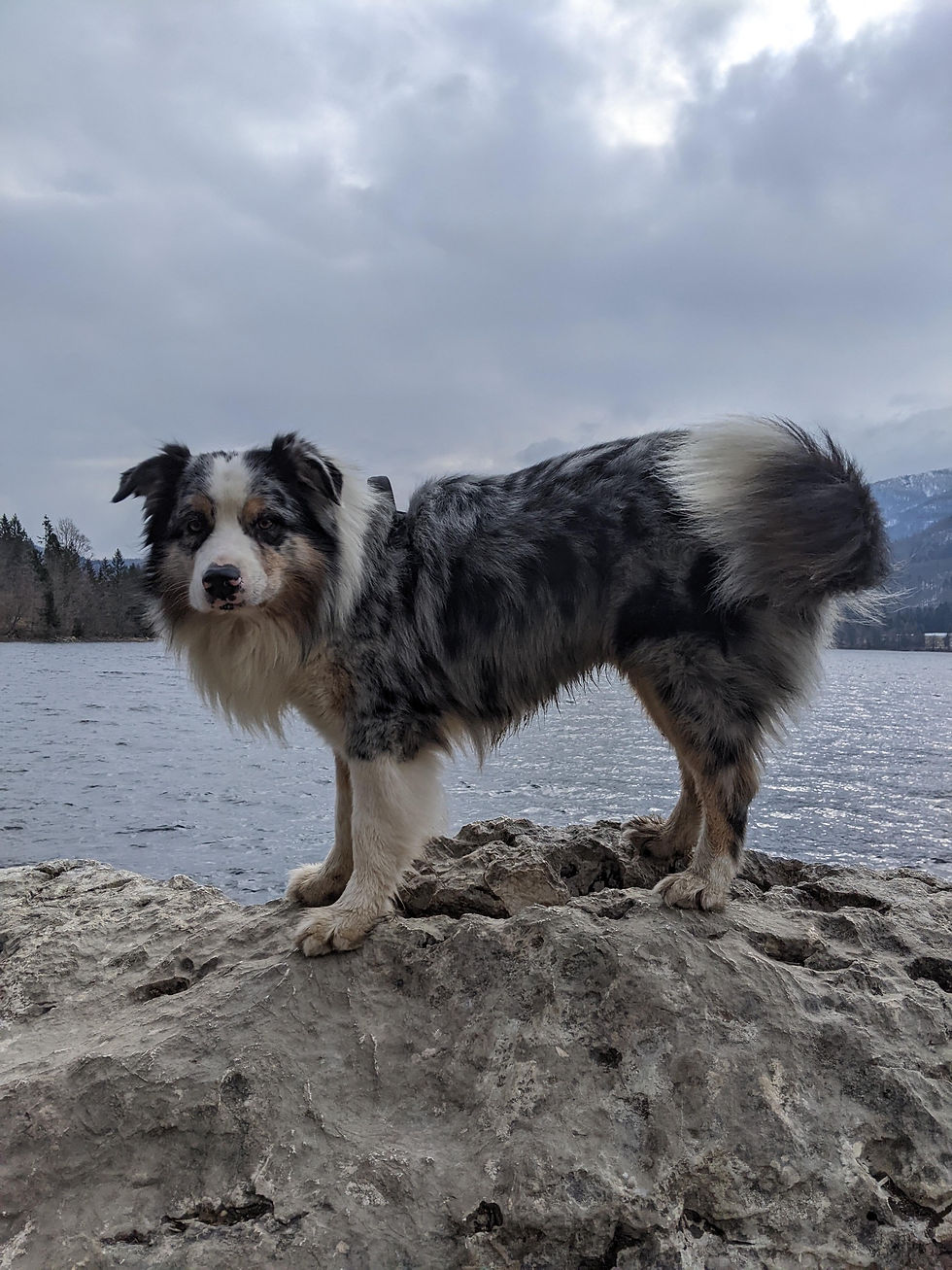
Lake Bohinj (Slovenia) - is it safe for dogs?
Australian Shepherds generally love freedom and water. My dog and I walked between 10 and 20 kilometres every day, and he enjoyed walks around the lake most of all, swimming in it regardless of the water temperature.
Recently, I have noticed that dog owners keep their dogs on a leash around the lake and no longer let them enter the water.
At the same time, I am not sure they realise that the main danger may not lie in the lake itself, but along the shoreline.
In June 2022, veterinarian Pierre-François Gobat from the Swiss canton of Neuchâtel described the death of a dog that had bathed briefly in Lake Neuchâtel earlier that day:
"We know it started convulsing after seven to eight minutes. The neurotoxins produced by certain cyanobacteria attack the nervous system. It goes very, very fast. As soon as the nerves that control the diaphragm are affected, asphyxiation sets in."
Seven minutes after stepping out of the water, the dog began to convulse. First the hind legs, then the entire body. The owner could only watch. The dog collapsed on its side; its breathing became shallow, fast, panicked. Then slower and slower. The diaphragm — the muscle that lifts the lungs — stopped contracting. The dog was suffocating, not because anything had blocked its airways, but because its nerves had stopped sending the command: breathe.
The dog died before its owner could reach the veterinary clinic.
This is not an exception. It is a pattern documented across Europe over the past two decades — in several European countries, including in alpine and pre-alpine regions. Dog owners in Berlin, in Bavaria, in Switzerland, in southern France, in the French Alps — all describe the same thing: a dog enters water that looks completely normal, clean, beautiful; minutes to hours later it starts showing signs of neurological distress; and often dies before the owner can get it to a veterinarian.
What is the same in all these cases is not a visible water bloom that the owner could have noticed.
What is the same is something that in Slovenian we have most often simply called gošča — a cyanobacterial coating that grows on the bottom and along the shores of lakes and rivers, not in the water column. And something that standard bathing-water monitoring does not detect.
Is bathing in Bohinj safe for me?
What cyanobacterial mat actually is
Until now, we have heard of "lake blooms" — that greenish-bluish water seen in photographs of Lake Bled in early 2020, or on images of Lake Garda in summer. These are planktonic blooms: cyanobacteria floating in the water column, the water turning turbid, taking on colour, sometimes smelling.
Mat is something else. These cyanobacteria do not float. They grow attached to a substrate — on stones, gravel, aquatic moss, wood remnants along the shore, and on other aquatic plants. Scientifically, we speak of phytobenthos, or of benthic biofilms and mats; in the international literature the term benthic mat is used. Phytobenthos is a broader concept (it covers all attached phototrophic organisms); for our purpose — a plain word for the visible cyanobacterial coating on the bottom — we will use the Slovenian word gošča.
Imagine a dark green to brownish-black layer, from a few millimetres to several centimetres thick, covering the stones in shallow areas near the shore. To the touch it is slippery, slimy. It has a distinctive musty, mouldy smell — which attracts dogs, because they perceive it as a "good meal".
And here is the important part: the water above the mat is completely clear.
A dog owner looking at a lake from the shore sees water that appears clean and beautiful. They do not see the greenish, turbid bloom that would warn them. The cyanobacteria are on the bottom, not in the water. The dog jumps in, swims, swallows some water, licks itself when it gets out, and through that licking ingests remnants of the mat that have clung to its coat.
In Lake Mandichosee in Bavaria, in 2019, samples containing significant mat material yielded anatoxin concentrations of up to 68,000 micrograms per litre, while in open water the lowest value measured was 0.1 micrograms per litre. A dog that ate a few grams of mat ingested a lethal dose. The water in which people accidentally bathed at the same beach was chemically "clean".
This is why standard bathing-water monitoring — which takes a water sample from the water column, typically at a depth of around thirty centimetres — systematically fails to detect this hazard. Under EU Directive 2006/7/EC, bathing-water quality is classified on the basis of two microbiological parameters: Escherichia coli and intestinal enterococci. Cyanobacteria are not a quantitative classification parameter, but they can trigger management measures and public warnings when competent authorities identify a risk.
The consequence is simple: when a dog owner checks an official bathing-water rating before a walk and sees "excellent", they are getting accurate information about whether they risk a gastrointestinal infection from faecal bacteria. They are not getting information about whether they risk losing their dog to neurotoxins in a cyanobacterial mat on the bottom.
Dogs dying after swimming in lakes
Berlin, 2017
Twelve dogs, aquatic moss, and a toxin beneath the surface
In May 2017, dogs began to die in Berlin's Lake Tegel — a mesotrophic urban lake, a popular spot for walks, where people had been swimming for decades. A study later published in Toxins in 2018 by a team led by Jutta Fastner documented that at least twelve dogs were affected in a short period. Despite intensive veterinary care, most did not survive.
What investigators subsequently found surprised the scientific community. Cyanobacteria of the genus Tychonema were growing on aquatic moss (Fontinalis antipyretica) submerged below the surface. In summer, due to water movement and wind, the moss detached and drifted ashore as brownish-green patches, attracting dogs by its distinctive smell. In the stomach contents of the dead dogs, scientists measured exceptionally high anatoxin concentrations of up to 8,700 micrograms per litre.
There was no visible bloom on the water surface. The owners of the dogs had not seen anything unusual. The water looked normal.
The Berlin authorities (Land Berlin / LAGeSo, the State Office for Health and Social Affairs) issued warnings to dog owners after the incident, advising that animals be kept on a leash and away from aquatic plants near the shore. Toxins in Tegeler See have been detected since 2017. In the following years, scientific groups in Germany developed systematic studies of cyanobacteria on the bottom and along the shore, and recommendations for supplementing the monitoring system, which by default tracks only the microbiology of bathing waters.
Mandichosee, Bavaria, 2019
68,000 micrograms of anatoxin in the mat
In August 2019, in the small mesotrophic reservoir Mandichosee on the river Lech in Bavaria — a recreational water body — the first dog died. Two more died in the following days. All followed the same pattern: bathing, licking the coat, convulsions, death within hours.
A team led by Franziska Bauer from the Technical University of Munich conducted thorough analyses. Published in Toxins in 2020, the findings showed that the deaths were caused by Tychonema, which had formed mats on the bottom of the lake. In the stomach contents of the dead dogs, anatoxin-a and dihydroanatoxin-a were measured. In the mats, concentrations of up to 68,000 micrograms of anatoxin per litre were recorded — one of the highest values ever documented in Europe. The surface water of the lake contained only 0.1 micrograms per litre.
The Bavarian regional administration immediately installed warning signs and banned dog bathing in Mandichosee. Following this incident, systematic research and preparation of recommendations for supplementing the monitoring of cyanobacteria on the bottom and along the shore took place in Germany, showing that classical water-column sampling fails to detect this risk.
Lac de Neuchâtel, Switzerland, 2020 and 2022
Six dogs in twenty-four hours, then one more two years later
At the end of July 2020, in the Swiss canton of Neuchâtel, near the outflow of the river Areuse into Lake Neuchâtel, six dogs died within twenty-four hours. According to witness accounts, three of them died before reaching a veterinarian. Four additional dogs were rescued at the last minute.
The police initially suspected deliberate poisoning by an unknown third party. Only when a toxicology laboratory in Berlin analysed the stomach contents of two of the dead dogs was the presence of anatoxin-producing or potentially anatoxin-producing cyanobacteria officially confirmed — including genera later linked to the Microcoleus group. The stomach contents contained lethal doses of anatoxin.
The Neuchâtel cantonal administration immediately closed the beaches between Colombier and the Areuse outflow. The Vaud authorities advised against bathing along the entire Neuchâtel and Vaud shore of the lake. In the following days, the municipal police systematically inspected the shoreline, searching for cyanobacterial mats on the bottom and in the shallows.
Two years later, in June 2022, another dog died at the same location. Convulsions began seven to eight minutes after it left the water. Veterinarian Pierre-François Gobat then said:
"These cyanobacteria will multiply when they fall back to the bottom of the lake, and they will return to the surface as soon as the water reaches a sufficient temperature. This will become recurrent with climate warming, so we will have to live with it."
The institutional response this time differed from 2020. The beaches were not closed — the canton only issued a warning. The crucial difference was that this time it was known: this is a specific, localised focus of cyanobacteria at the Areuse outflow. After two years of research, scientists had identified this location as a persistent hotspot.
This event triggered extensive molecular studies of cyanobacteria growing on the bottom of rivers and lakes. A research group led by Pilar Junier (University of Neuchâtel) published a study in Water Research X in 2024, demonstrating that a cohesive cluster of strains of the genus Microcoleus is responsible for such blooms worldwide — from Switzerland to New Zealand, from the United States to France, from Canada to German Bavaria.
Early French cases, early 2000s
The first systematic study of cyanobacteria on the bottom
One of the earliest well-documented cases in Europe comes from France. In the early 2000s, in the valley of the river Tarn (Aveyron region, southern France) and in adjacent areas, recurring dog deaths occurred after bathing in shallow, calm sections of rivers. Veterinarians observed the same pattern: bathing in shallow, calm parts of the river, where a dark brownish-greenish layer could be seen on the stones.
A team led by Muriel Gugger and colleagues published the first systematic description in Toxicon in 2005: the cyanobacterium Phormidium favosum, growing on stones in the riverbed, was producing anatoxin-a. This was the first documented European example of "a bloom without a bloom" — a toxic phenomenon that completely escaped all standard water-quality measurements.
The French Regional Health Agency (ARS) progressively established a warning system over the following years, which is used by agencies in regions where such blooms are documented. During hot seasons, ARS issues warnings via local media, places warning signs along rivers, and specifically alerts dog owners.
The Loire, France, August 2017
Fourteen poisonings, eight deaths in three weeks
In the department of Maine-et-Loire, in the Loire valley, fourteen dog poisonings, of which eight resulted in death, were officially recorded between 7 and 25 August 2017, following bathing or drinking from the river. Competent French authorities issued official warnings and advised against water-based recreational activities in the affected areas.
The cyanobacteria identified in the sequence of French cases include the genera Oscillatoria and Phormidium, which form mats on stones and in shallow parts of the riverbed. These cyanobacteria produce neurotoxins, and some species also produce hepatotoxins.
The French Regional Health Agency (ARS) developed warning procedures for recreational waters in the following years: regular inspections of tributaries during hot seasons, direct communication with municipalities and tourist information centres, prohibition of dog bathing in risk areas, and information campaigns for veterinarians and local residents.
According to Sciences et Avenir, which documented the French cases in 2017 and updated the coverage in 2022, no human deaths have been recorded in France from cyanobacteria in recreational waters; dog deaths, however, number in the dozens each year.
Stausee Ottenstein, Austria, 2023
A warning instead of waiting for casualties
In August 2023, the Austrian Agency for Health and Food Safety (AGES) detected potentially toxic cyanobacteria in the Stausee Ottenstein reservoir in Lower Austria and notified the competent authorities, who advised against bathing (Badewarnung). Dog deaths were not directly confirmed in this case; the action was preventive.
This is the Austrian approach: a preventive model, in which there is no need to wait for animals or people to die. AGES operates the Badegewässer Monitoring system, which includes an online database and an application providing current measurements and bathing-water profiles. The system covers several hundred recreational waters in Austria and includes notifications about cyanobacteria, which are not part of standard bathing-water quality measurements.
Lago Maggiore, Italy
Proof that even a "clean" lake is not immune
In 2014, an Italian research team led by Cristiana Callieri from the Institute of Water Research in Pallanza (CNR-IRSA) published a breakthrough in PLoS ONE: cyanobacterial blooms are possible even in oligotrophic lakes.
Lago Maggiore — a deep pre-alpine lake long considered one of the cleanest in Italy — in 2005 experienced a mass occurrence of the cyanobacterium Dolichospermum lemmermannii, previously absent from its pelagic zone. Callieri and colleagues showed that this was driven by a combination of lake-level fluctuations, water warming, and pulses of nutrients from littoral biofilms. This is a planktonic "oligotrophic bloom", not a benthic mat of the type that affected Mandichosee or Tegel; and it is not directly linked to dog deaths.
The significance of this case is different: it shows that the assumption "the lake is clean, so this cannot happen here" is not scientifically tenable. Even an oligotrophic alpine lake can, under conditions of warming and hydrological fluctuations, undergo structural changes to its ecosystem.
Pelleautier, Hautes-Alpes, April and May 2026
A current case from the French Alps
In April and May 2026, as this article is being written, a similar story is unfolding at Lake Pelleautier in the French Alps. According to reports in Le Dauphiné Libéré and international media, two to three dogs have died and several more have fallen ill in the lake. All exhibited the same symptoms: vomiting, convulsions, hypersalivation.
The owner of the first dog said: "It was over in fifteen minutes."
The director of the local water authority, Vincent de Truchis, mentioned on 10 May 2026 a suspicion of cyanobacterial mats on the lake bottom, but according to reports, official findings had not yet exceeded warning thresholds, and the cause of death has not been definitively confirmed. The La Saulce gendarmerie opened a police investigation. Warning signs were posted.
This time, then, we are not facing definitive evidence — we are facing a pattern of institutional uncertainty that has been recurring across Europe over the past two decades: deaths, suspicion, slowly arriving results, parallel police investigations, and interim warnings.
And Bohinj
In the summer of 2025, several dogs also died at Lake Bohinj in Slovenia. The National Institute of Biology microscopically confirmed the presence of potentially toxic cyanobacteria in the mat in the Ukanc area, near the inflow of the Savica into the lake. Samples were sent to Austria for detailed analysis. The Municipality of Bohinj installed warning signs.
At the same time, precision is required: for one of the August dog deaths at Lake Bohinj, a subsequent autopsy showed that the dog had not died of anatoxin, but of ingesting pebbles. In another, June case, the toxicological picture was complex — a combination of metaldehyde and anatoxin, not a clear case of cyanobacterial poisoning.
The causal link between the individual deaths and cyanobacteria in Bohinj has therefore not been definitively established for all cases. What has been confirmed is the presence of potentially toxic cyanobacteria in the mat — which institutionally is the same pattern we have seen elsewhere. Bohinj is part of a European pattern, not a local exception.
What may concern us in this light is not the question "are we in a crisis", but the question of whether we are able to learn the way others have learned.
What other countries have done
Several competent authorities that have faced this problem over the past two decades have followed similar steps.
First, they acknowledged that the standard bathing-water directive structurally fails to detect the problem. They did not criticise it — they established a parallel systematic monitoring network that complements, rather than replaces, the existing one.
Second, they established a proactive approach instead of a reactive one. The Austrian AGES, the Swiss Service de l'écologie de l'eau, the German Umweltbundesamt (UBA) and regional bodies (such as LAGeSo in Berlin, LfU in Bavaria), and the French ARS — all have warning systems that, when there is suspicion of cyanobacterial mats on the bottom and along the shore, trigger ad hoc sampling and public notifications.
Third, they established continuous monitoring, not just occasional sampling. The most developed example is the LéXPLORE platform, which has been floating on Lake Geneva since February 2019. It is led by Professor Bastiaan Ibelings of the University of Geneva. Ibelings told the Tribune de Genève in 2025:
"Classical sampling carried out once or twice a month — sometimes only once a year — is not sufficient to effectively predict these phenomena. The best tool is continuous monitoring of water properties."
Fourth, they addressed nutrient sources in the catchment. In many alpine and pre-alpine regions, measures to reduce nutrients — sewage infrastructure, agriculture, point sources such as restaurants and campsites, tourism, and atmospheric deposition — are part of long-term lake management.
Fifth, they began to communicate openly. Bavaria, Austria, and Switzerland have mobile applications and websites where dog owners can see every day where bathing is permitted and where it is not. The French ARS issues warnings that are not hidden in institutional jargon — they are clear, direct, addressed to people.

What dog owners should do now
Until a systemic solution is in place, dog owners bear the responsibility themselves. Following recommendations from the Swiss University Hospital (CHUV, Dr Gilbert Greub) and the French Fondation 30 Millions d'Amis:
Before a walk, check official information from the municipality and the competent agencies. If warnings exist, respect them.
During the walk, observe the water and the shore. Look for a thick, slimy layer on the stones near the shore, brownish-greenish mat, patches of mat floating on the surface, and the distinctive musty smell. If you see or smell this, do not let your dog enter the water.
After bathing, rinse your dog thoroughly with clean water, especially the coat, before it can lick itself. Toxins that have clung to the fur during bathing become dangerous only when the dog ingests them while licking.
At the first symptoms — drooling, convulsions, breathing difficulties, muscular stiffness — go immediately to a veterinarian. Without a specific antidote, veterinary care involving respiratory support and gastric lavage can in some cases save the dog, but only if you arrive in time. In time means within minutes, not hours.
Conclusion
A dog in Neuchâtel died in seven minutes. Three dogs at Mandichosee died within hours. More than twelve dogs in Berlin in 2017. Six dogs at Neuchâtel in summer 2020, and one more in 2022. Fourteen poisonings, of which eight fatal, in the French region of Maine-et-Loire in August 2017. Recurring early cases in the French river Tarn in the early 2000s. Two to three dogs in the French Alps in April and May 2026.
All in waters that under standard classification had not been flagged as risky. In confirmed cases — or, in more recent cases, where a substantiated suspicion exists — the same problem recurs: a cyanobacterial mat that grows on the bottom and along the shore, invisible to the eye when one looks at the water, and undetected by standard bathing-water monitoring.
Elsewhere in Europe, lessons have been drawn from these incidents over the past two decades. After Lake Tegel 2017, scientific studies and warnings to dog owners were issued in Germany. On Lake Geneva, the LéXPLORE research platform has been operating as an example of continuous monitoring since February 2019. Austria has the AGES Badegewässer Monitoring with current bathing-water profiles. France has ARS warnings. Italy has the systematic CNR-IRSA monitoring at Lago Maggiore.
The question posed by the latest European case from Pelleautier to all of us, including dog owners in Slovenia, is not whether Bohinj will be the next case. The question is whether we will take anything away from the cases that others have already lived through.
Sources
Scientific studies on dog deaths and cyanobacteria growing on the bottom
Fastner J., Beulker C., Geiser B., Hoffmann A., Kröger R., Teske K., Hoppe J., Mundhenk L., Neurath H., Sagebiel D., Chorus I. (2018): "Fatal Neurotoxicosis in Dogs Associated with Tychoplanktic, Anatoxin-a Producing Tychonema sp. in Mesotrophic Lake Tegel, Berlin". Toxins 10(2): 60.
Bauer F., Fastner J., Bartha-Dima B., Breuer W., Falkenau A., Mayer C., Raeder U. (2020): "Mass Occurrence of Anatoxin-a- and Dihydroanatoxin-a-Producing Tychonema sp. in Mesotrophic Reservoir Mandichosee (River Lech, Germany) as a Cause of Neurotoxicosis in Dogs". Toxins 12(11): 726.
Gugger M., Lenoir S., Berger C., Ledreux A., Druart J.-C., Humbert J.-F., Guette C., Bernard C. (2005): "First report in a river in France of the benthic cyanobacterium Phormidium favosum producing anatoxin-a associated with dog neurotoxicosis". Toxicon 45(7): 919–928.
Junier P. et al. (2024): "A cohesive Microcoleus strain cluster causes benthic cyanotoxic blooms in rivers worldwide". Water Research X.
Callieri C., Bertoni R., Contesini M., Bertoni F. (2014): "Lake Level Fluctuations Boost Toxic Cyanobacterial 'Oligotrophic Blooms'". PLoS ONE 9(10): e109526.
Foss A.J., Aubel M.T. et al. (2022): "Confirmation Using Triple Quadrupole and High-Resolution Mass Spectrometry of a Fatal Canine Neurotoxicosis following Exposure to Anatoxins at an Inland Reservoir". Toxins.
Media on European cases
Tribune de Genève (June 2022): "Un chien aurait été victime des cyanobactéries" — second dog death at Lac de Neuchâtel.
Tribune de Genève (August 2020): "Les cyanobactéries mettent-elles la baignade en péril?" — analysis of six dog deaths at Neuchâtel 2020.
Tribune de Genève (July 2025): "Cyanobactéries: comment protéger son chien et soi-même" — recommendations from CHUV, Dr Gilbert Greub.
Fondation 30 Millions d'Amis (15 July 2025): "Attention danger: les cyanobactéries peuvent empoisonner votre chien lors d'une baignade".
Sciences et Avenir (24 August 2017, updated 19 December 2022): "Cyanobactéries: 5 questions sur les risques pour la santé humaine".
Le Dauphiné Libéré (April–May 2026): series of articles on Lake Pelleautier (Hautes-Alpes, France). Connexion France (April–May 2026): "Two dogs die after drinking from lake in south-east France".
Slovenian sources
ARSO (Slovenian Environment Agency): "Quality of bathing waters in Slovenia 2024".
ARSO Environmental Indicators: "Quality of inland bathing waters".
Ciano.si (National Institute of Biology): "Glossary" and "Results 2023, 2024" — Slovenian technical terminology (phytobenthos, biofilm, gošča).
24ur.com (August 2025): "Bacteria from Lake Bohinj sent to Austria for analysis".
siol.net (November 2025): "Dog in August died after bathing in Lake Bohinj due to ingestion of pebbles".
International institutions and regulations
AGES (Austria): "Badegewässer Monitoring".
LéXPLORE platform — University of Geneva, Prof. Bastiaan Ibelings.
Land Berlin / LAGeSo (Landesamt für Gesundheit und Soziales) — warnings about cyanobacteria in Tegeler See.
Umweltbundesamt (UBA, Germany) — technical guidelines on cyanobacterial risks.
WHO: "Cyanobacterial toxins" — guidelines.
EU Directive 2006/7/EC on the management of bathing-water quality.

